- Free UK delivery · same-day dispatch before 3pm
- Independent third-party testing by PeptideVerify
- Shop all research peptides
- Learn: guides and research tools
Quality & specifications
Peptide purity testing and quality
Every compound we supply is ≥99% (HPLC), with identity confirmed by LC-MS and independent third-party testing by PeptideVerify. Here is what arrives in your parcel, what each test shows and how orders reach you.
For research use only. Not for human or veterinary use. Sold strictly for in-vitro laboratory research; not for diagnosis or treatment.
What arrives in your parcel
Orders are packed in the United Kingdom and handed to Royal Mail Tracked 24 as a tracked parcel. Inside, each compound arrives in its own sealed vial, labelled and ready to log into your laboratory's inventory.
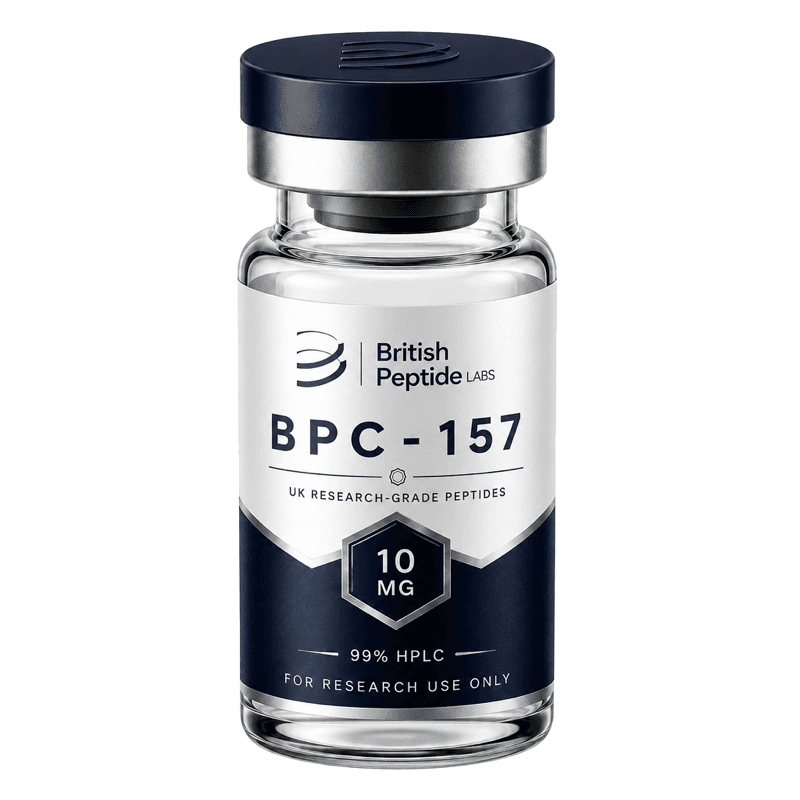
- The sealed vial: clear glass, closed by a stopper under a flip-off cap and an aluminium crimp seal. Research compounds are supplied as a lyophilised powder.
- The label: the product name, the net content of the vial and its HPLC purity, so every vial is identified at a glance on the bench.
- Protective packing that holds the vials in place in transit.
- A Royal Mail Tracked 24 parcel, with a tracking number you can follow from dispatch to your door.
Keep each vial sealed until your laboratory is ready for it. The storage section below gives the temperatures for the sealed vial, and the product page lists everything else on record for it: identifiers, appearance, purity and net content.
Your order confirmation lists every product and vial size in the parcel, so checking the delivery against it takes a minute. If anything is not as ordered, email us with your order number and we will put it right.
What each product page documents
Every research compound has its own product page, listing:
- Identifiers: synonym, CAS number, molecular formula, molecular weight and sequence.
- Appearance of the material as supplied.
- Purity: ≥99% (HPLC).
- Net content per vial for each presentation.
- Storage for the sealed vial.
The glossary explains each of these terms. Every value comes from our catalogue record for the compound, and the same identifiers appear on its research-area hub.
Purity: ≥99% (HPLC)
Every research compound we supply is ≥99% (HPLC). The figure is stated on each product page and printed on the vial label. In plain terms, at least 99 parts in every 100 of the UV-absorbing material in the vial are the target compound, measured by the method below.
HPLC (high-performance liquid chromatography) is the standard method for measuring peptide purity. The sample is carried through a column packed with a non-polar stationary phase by a gradient of water and acetonitrile, and each component leaves the column at its own retention time. A UV detector, usually set near 214 nm where the peptide bond absorbs, records each component as a peak. Purity is the area of the main peak as a share of the total peak area.
A high main-peak share means closely related species, such as sequences missing a residue or carrying an extra one, are present only at low levels. Because these species differ from the target by little more than one amino acid, the separation has to be sharp enough to resolve them as their own peaks.
HPLC purity describes how much of the UV-absorbing material is the target peptide. It is a different measure from net peptide content, which also accounts for counter-ions and water. Two guides cover this in more detail: HPLC and Peptide Purity: How It Is Measured and Peptide Purity vs Net Peptide Content.
Starting from material of known purity and identity means fewer variables to account for before an experiment begins, and a cleaner record when the results are written up.
Identity: LC-MS
Purity says how much of the sample is one compound; identity says which compound it is. LC-MS (liquid chromatography–mass spectrometry) answers that second question. The sample is separated by liquid chromatography, as in HPLC, and then passed into a mass spectrometer, which measures the mass-to-charge ratio (m/z) of the ions it forms.
Peptides are ionised by electrospray, so a larger molecule appears as a series of multiply charged ions. Deconvolution turns that series into a single neutral mass, which is checked against the expected molecular weight calculated from the molecular formula on the product page. A match confirms the compound's identity, including any modification it carries, such as a lipid chain, a lactam bridge or a bound copper ion, because each one shifts the mass by a known amount. A missing or extra amino acid moves the mass by between 57 Da (glycine) and 186 Da (tryptophan), far outside the tolerance of the measurement.
The two tests answer different questions, which is why we rely on both. HPLC alone cannot tell apart two compounds that leave the column at similar times, and a mass alone cannot say how much of the sample is the target. Together they show that the main peak is the intended compound and that it makes up the stated share of the sample.
Mass Spectrometry and Peptide Identity walks through a spectrum step by step.
Independent third-party testing by PeptideVerify
PeptideVerify (Verify Analytik Ltd) is an independent third-party testing service. It analyses our compounds and issues each report to British Peptide Labs, naming the report number, the issue date, the methods and the results for the sample.
- Independent third-party testing by PeptideVerify, using HPLC and LC-MS.
- Reports prepared for British Peptide Labs, published in the COA Library.
- The certificate for your batch, emailed whenever you ask.
Each report follows the same four-step method:
- Sample: a sample of the compound is received and logged by the testing service.
- HPLC purity: the sample is run by HPLC and the main-peak share recorded.
- LC-MS identity: the measured mass is checked against the expected mass.
- Report: the results are issued to British Peptide Labs under a numbered report.
Open a published report directly: the GLP-3 certificate of analysis and the Semaglutide certificate of analysis, each with its key facts and the full PDF.
Every report in the COA Library is issued to British Peptide Labs / AODAEMON LTD and shown as the document states it: the issuer, the date and the methods. Each one is published in full as a PDF, exactly as issued, with its key facts set out beside the download.
For the certificate for the batch you received, email info@britishpeptidelabs.com with your order number. What each part of a certificate shows is explained in How to Read a Peptide Certificate of Analysis.
Storage of sealed vials
Research compounds are supplied as a lyophilised powder in a sealed vial. For these compounds, each product page gives the storage for the sealed vial as: Store at 2–8 °C short term, or at −20 °C and below for long-term storage. Protect from light and avoid repeated freeze-thaw cycles.
Lyophilisation removes water from the material by freeze-drying, leaving a dry, porous solid. Warmth, moisture and light are what that solid is kept away from in storage. On arrival, move the vial straight into cold storage; its label carries the product name and net content for your inventory records.
The statement applies to the sealed vial as supplied. How to Store Lyophilised Peptides explains why cold, dry and dark storage matters for the solid.
Dispatch and delivery
Orders are packed and dispatched from the United Kingdom. Orders placed before 3pm Mon–Sat are packed the same working day and handed to Royal Mail Tracked 24.
Royal Mail Tracked 24 delivers the next working day after dispatch, and every order is tracked from dispatch to delivery.
- Next-day tracked delivery with Royal Mail Tracked 24.
- Same-day dispatch on orders placed before 3pm, Mon–Sat.
- Free delivery to every UK address, on all orders.
Once your order is dispatched, the order tracking page shows its tracking number: enter your order number and the email you ordered with. Orders placed after the cut-off, or on a Sunday, go out on the next working day. Delivery and returns are set out on our Shipping & Returns page.
Shop by research area
Every research compound in the catalogue belongs to one research area, grouped by molecular class or research field. Each hub lists its compounds with their identifiers, and each product page carries the full specification, the vial sizes and the price.
The areas run from short linear fragments and cyclic heptapeptides to lipidated analogues of thirty to forty residues, plus the dinucleotide NAD+. Choose an area to see its compounds together, or go straight to a product:
- Incretin & Amylin Analogues: GLP-3, Tirzepatide, Semaglutide and Cagrilintide
- Peptide Fragments: BPC-157, TB-500, BPC-157 / TB-500 Mix and KLOW
- GHRH, GHS-R & IGF-1 Analogues: Ipamorelin, Tesamorelin and IGF-1 LR3
- Melanocortin & Copper Peptides: GHK-Cu, MT2 and PT-141
- Mitochondrial Compounds: MOTS-c, NAD+ and SS-31
- Neuropeptides: Selank and Semax
Or browse all research peptides in one place.
Who we are
- Trading name
- British Peptide Labs
- Legal entity
- AODAEMON LTD — a private limited company registered in England and Wales, Companies House No. 17176945.
- VAT status
- Not VAT registered
- Registered office
- Office 113860 Tottenham Court RoadFitzroviaLondonW1T 2EWUnited Kingdom
- Contact
- info@britishpeptidelabs.com