- Free UK delivery · same-day dispatch before 3pm
- Independent third-party testing by PeptideVerify
- Shop all research peptides
- Learn: guides and research tools
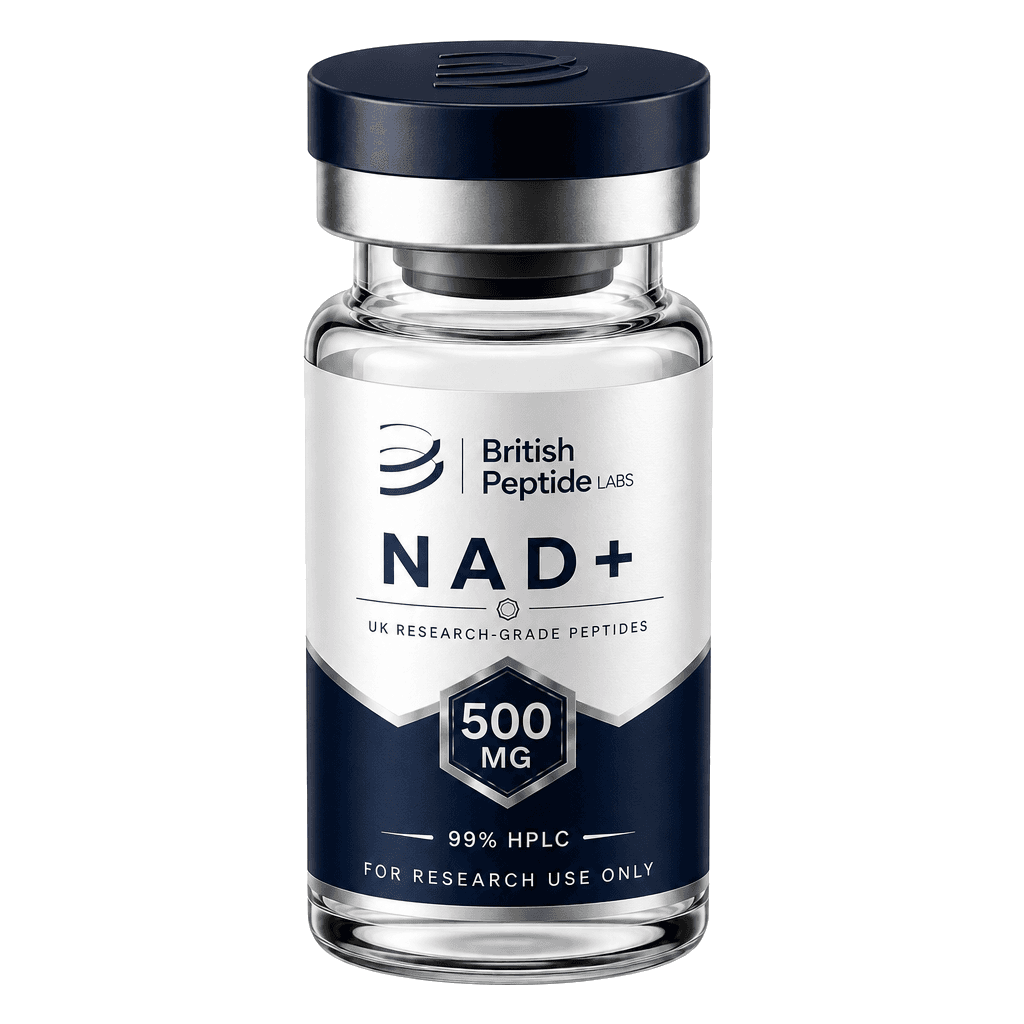
NAD+
In stock · 500 mg
£70.00
£0.14/mg
Research area
For research use only. Not for human or veterinary use. Sold strictly for in-vitro laboratory research; not for diagnosis or treatment.
The three compounds in this research area are catalogued together for their association with mitochondrial research, but they belong to different chemical classes. MOTS-c is a synthetic linear peptide of sixteen residues, Met-Arg-Trp-Gln-Glu-Met-Gly-Tyr-Ile-Phe-Tyr-Pro-Arg-Lys-Leu-Arg, whose sequence corresponds to a short open reading frame in mitochondrial DNA. SS-31 is an aromatic-cationic tetrapeptide, D-Arg-Dmt-Lys-Phe-NH2, that alternates basic and aromatic residues; it contains a D-arginine, the non-proteinogenic residue 2′,6′-dimethyltyrosine and a C-terminal amide. NAD+ (β-nicotinamide adenine dinucleotide) is not a peptide: it is a dinucleotide coenzyme, C21H27N7O14P2, formed from nicotinamide mononucleotide and adenosine monophosphate joined through a pyrophosphate linkage. Each product page lists the compound's formula and molecular weight, and the sequence of each peptide.
In stock · 500 mg
£70.00
£0.14/mg
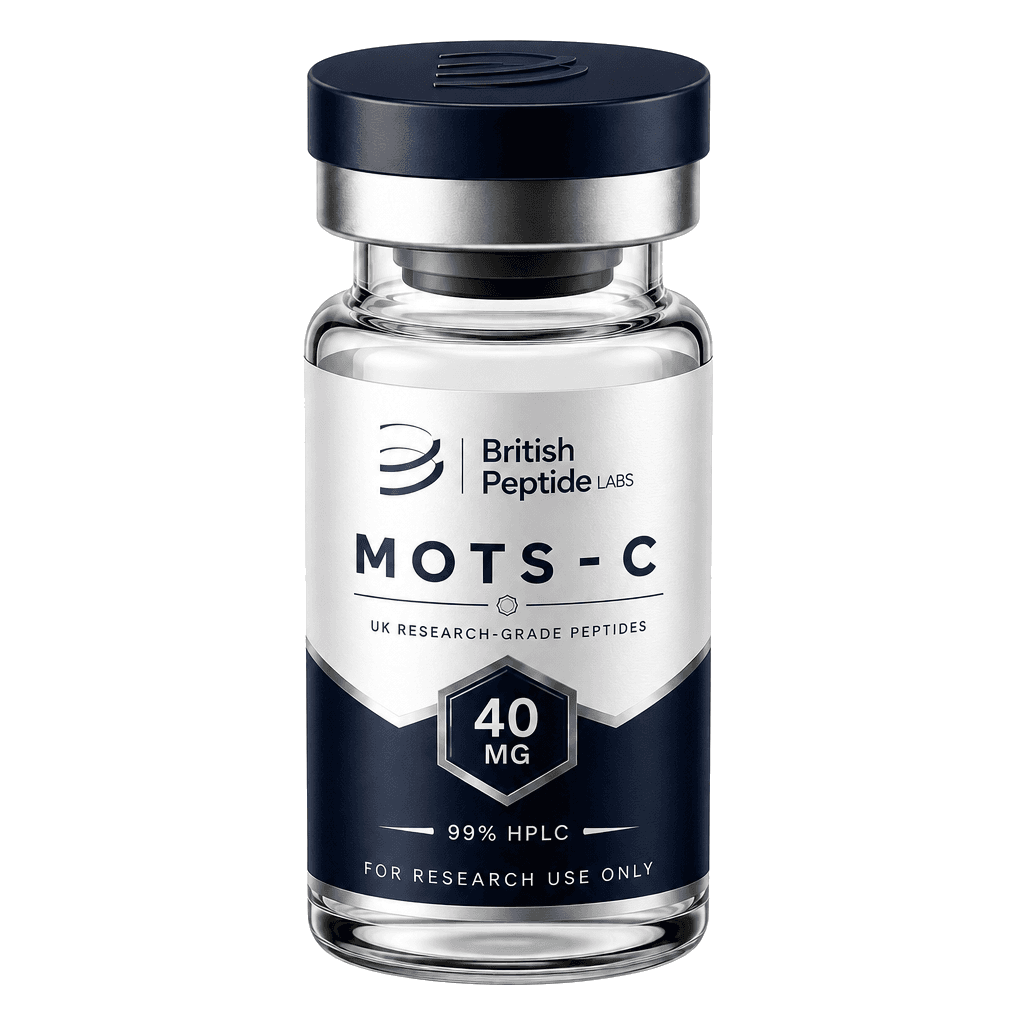
In stock · 40 mg
£80.00
£2.00/mg
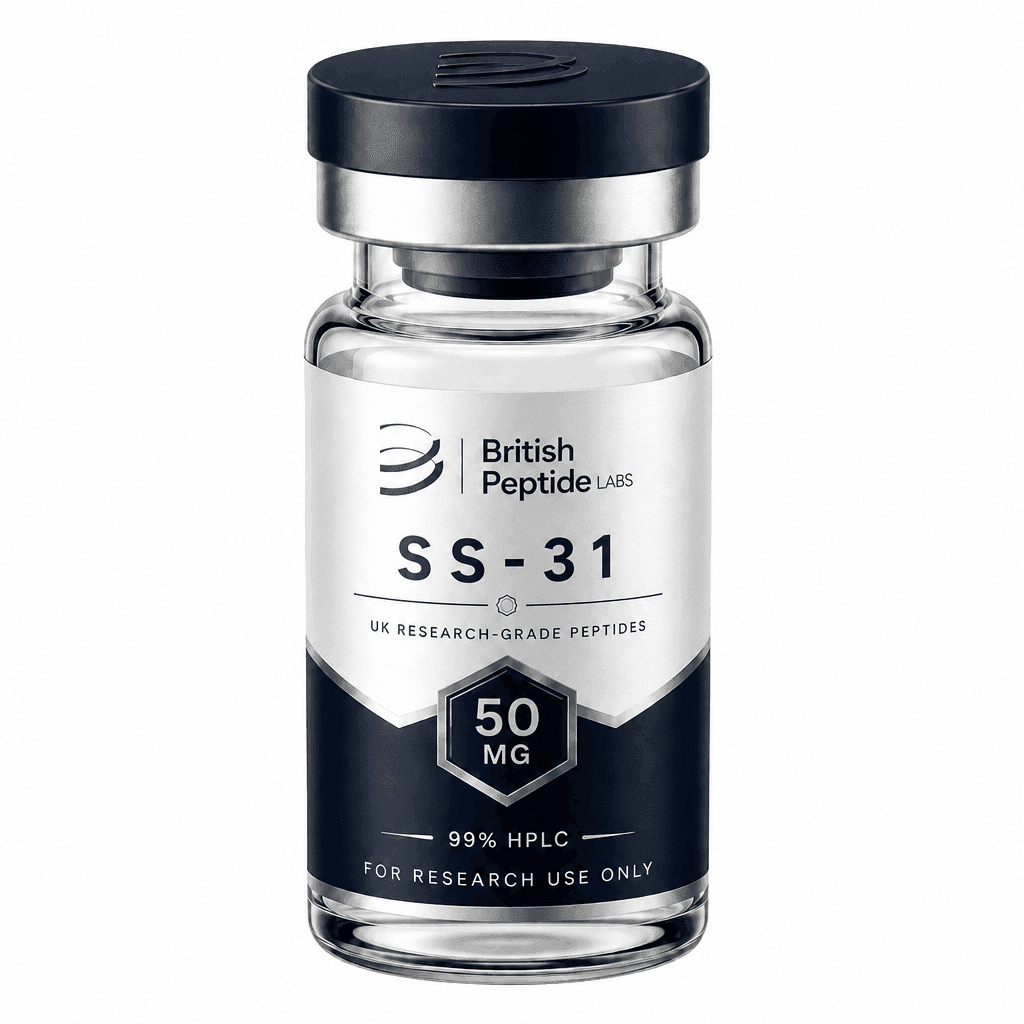
Out of stock · 50 mg
£150.00
£3.00/mg
The three compounds here are grouped by research field rather than molecular class, so their structures have little in common. MOTS-c is a linear peptide of sixteen standard amino acids, H-Met-Arg-Trp-Gln-Glu-Met-Gly-Tyr-Ile-Phe-Tyr-Pro-Arg-Lys-Leu-Arg-OH, with free termini. Four of its residues are basic (three arginines and a lysine) and four are aromatic (a tryptophan, two tyrosines and a phenylalanine), and its two methionines account for the two sulfur atoms in its formula, C101H152N28O22S2. A single glutamic acid is its only acidic residue, so the chain is strongly basic overall.
SS-31 is a tetrapeptide, H-D-Arg-Dmt-Lys-Phe-NH2, of the aromatic-cationic class: basic and aromatic residues alternate along the chain. It contains two features uncommon in short synthetic peptides, a D-arginine at the N-terminus and 2′,6′-dimethyltyrosine (Dmt), a tyrosine carrying two methyl groups on its aromatic ring, and it ends in a C-terminal amide. Its basic groups are the arginine guanidine, the lysine side-chain amine and the free N-terminal amine.
NAD+ (β-nicotinamide adenine dinucleotide) is not a peptide and contains no amino acids. It is a dinucleotide, C21H27N7O14P2: nicotinamide mononucleotide and adenosine monophosphate joined through a pyrophosphate (diphosphate) linkage, with each half built on a D-ribose sugar. The positive charge in its name sits on the nitrogen of the nicotinamide ring, and NAD+ is the oxidised member of the NAD+/NADH redox pair.
The table lists MOTS-c at 2174.6 g/mol, SS-31 at 639.79 g/mol and NAD+ at 663.43 g/mol, so a tetrapeptide and a dinucleotide sit within about 25 g/mol of each other while the sixteen-residue chain is more than three times heavier. Residue counts apply to the two peptides, and NAD+ is described by its formula. The price column, per milligram of each vial's content, is the clearest way to read the area, because the dinucleotide is supplied in a far larger vial than either peptide.
Residue-level detail sits on each product page. Within this area, read the structure notes on MOTS-c and SS-31.
This is the one research area in the catalogue grouped by research field rather than by molecular class, and it is deliberately broad. It holds a sixteen-residue linear peptide, a four-residue aromatic-cationic peptide and a dinucleotide that contains no amino acids at all. What the three share is the field they are catalogued for, so the identifiers, rather than the area label, are the guide to each compound's chemistry, and every row of the table below carries the full formula and molecular weight.
Within the area, chemistry splits the three cleanly. MOTS-c and SS-31 are peptides, characterised by sequence and residue count, and both are strongly basic: MOTS-c carries three arginines and a lysine, SS-31 a D-arginine and a lysine. NAD+ is described by its two nucleotide halves and their pyrophosphate linkage instead, and its formula is the only one in the area to contain phosphorus. Of the three, SS-31 alone carries a non-proteinogenic residue, the 2′,6′-dimethyltyrosine at position 2.
For that reason this hub reads each compound on its own terms, by the chemistry of its class rather than by the label it shares. The peptides are read by sequence, residue count and C-terminal group, and the dinucleotide by its formula, its pyrophosphate linkage and its ultraviolet absorbance at 260 nm, which the analytical notes below describe in more detail. Each product page carries the full identifiers for its compound.
Because the classes differ, so do the methods. Both peptides are analysed by reversed-phase HPLC with mass spectrometry for identity, but their aromatic content shapes the ultraviolet picture: MOTS-c, with a tryptophan and two tyrosines, absorbs well at 280 nm, and the Dmt and phenylalanine of SS-31 give it measurable absorbance there too. MOTS-c's two methionines are the likeliest sites of oxidation, each adding 16 Da. SS-31 is short and strongly cationic, so it can be weakly retained on reversed-phase columns unless an ion-pairing agent is present, and it gives an intense series of multiply charged ions in electrospray mass spectrometry. MOTS-c, at 2174.6 g/mol, also appears as a short series of multiply charged ions rather than a single peak.
NAD+ is a small, polar molecule and is usually analysed by HPLC with ultraviolet detection at 260 nm, where the adenine ring absorbs, often on ion-pair reversed-phase or hydrophilic-interaction columns. Relevant related substances are nicotinamide, ADP-ribose and NADH, which shows an additional absorbance band at 340 nm and so can be distinguished spectroscopically. Because NAD+ has no peptide bond, the low-wavelength region that suits the two peptides is of little value for it. Like lyophilised peptides, NAD+ is hygroscopic, so water content belongs in a full specification.