- Free UK delivery · same-day dispatch before 3pm
- Independent third-party testing by PeptideVerify
- Shop all research peptides
- Learn: guides and research tools
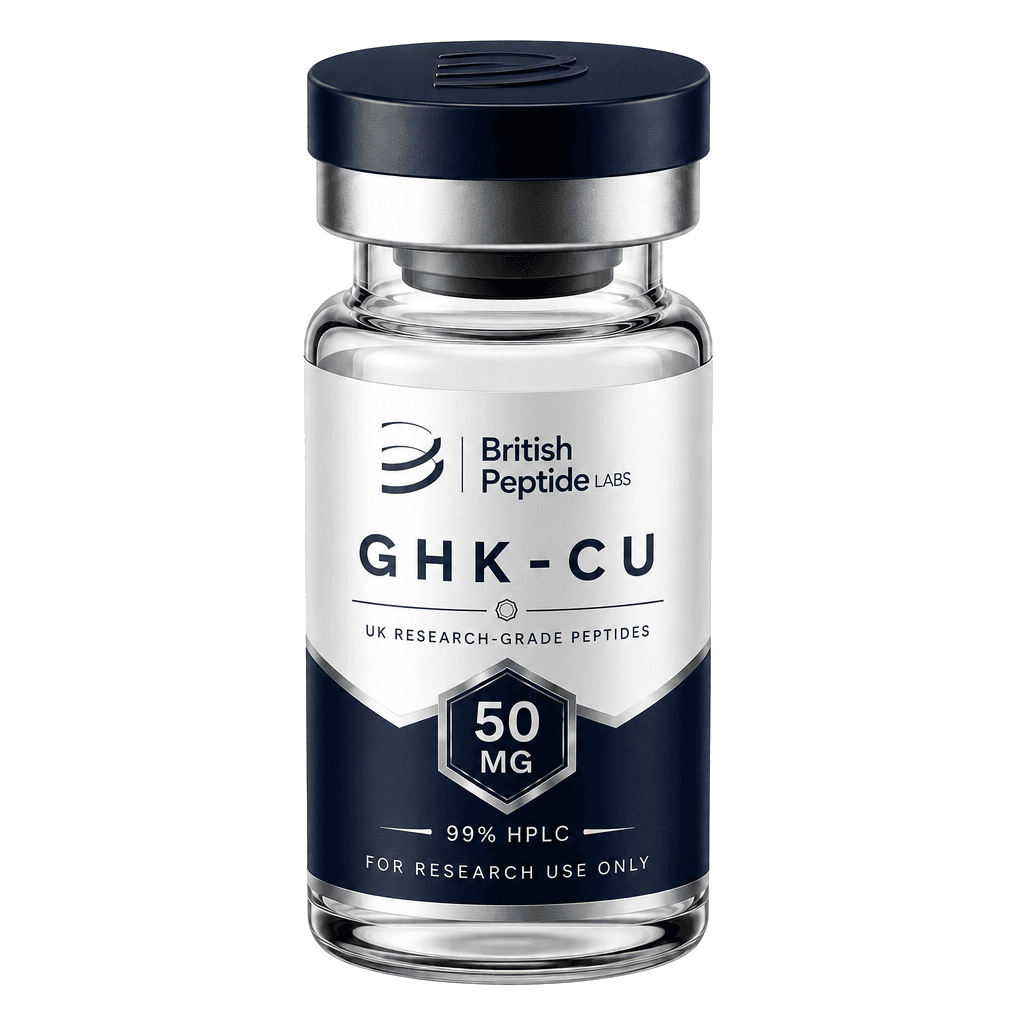
GHK-Cu
In stock · 50 mg
£20.00
£0.40/mg
Image 1 of 1
Melanocortin & Copper Peptides
Also written bremelanotide · PT141
PT-141 is a synthetic cyclic heptapeptide. Supplied as a lyophilised powder in a sealed vial for laboratory research. Available in a 10 mg presentation.
£4.00 per mg
≥99% purity (HPLC) · Independent third-party testing by PeptideVerify · COA Library
Free next-day tracked delivery on every order · Royal Mail Tracked 24
PT-141 is a synthetic cyclic heptapeptide, Ac-Nle-cyclo[Asp-His-D-Phe-Arg-Trp-Lys]-OH, and a ligand of the melanocortin receptor family. A lactam bond between the side chains of aspartic acid and lysine closes a ring of six residues, with N-acetyl-norleucine outside it at the N-terminus and D-phenylalanine as the ring's one D-configured residue. The C-terminal lysine ends in a free carboxylic acid, the only structural difference from the amide-terminated heptapeptide in the same research area.
The catalogue lists CAS number 189691-06-3, the molecular formula C50H68N14O10 and a molecular weight of 1025.18 g/mol. Because the acid and amide forms differ in mass by about 1 Da, mass spectrometry with adequate resolution, together with HPLC retention, is needed to tell them apart. Each presentation is supplied as a lyophilised powder in a sealed vial.
The seven residues, numbered from the N-terminus, are Nle1, Asp2, His3, D-Phe4, Arg5, Trp6 and Lys7. An amide bond between the side-chain carboxyl of Asp2 and the side-chain amine of Lys7 closes a six-residue ring, Asp2 to Lys7, and the N-acetyl-norleucine cap sits outside it. Norleucine, 2-aminohexanoic acid, is an unbranched isomer of leucine and not a coded amino acid.
Forming the lactam eliminates one molecule of water, so the ring is 18 Da lighter than the open chain. D-Phe4 is the one D-configured residue; a diastereomer with L-Phe in its place has exactly the same mass, which is why HPLC retention, not mass alone, tells the two apart.
His3, D-Phe4, Arg5 and Trp6 sit inside the ring with Asp2 and Lys7, so the four side chains that differ most in shape, imidazole, phenyl, guanidine and indole, are all held within the lactam.
PT-141 ends in a free carboxylic acid on Lys7, written -OH, while the N-terminus is acetylated. The formula C50H68N14O10 has one oxygen more and one nitrogen and one hydrogen fewer than an amide-terminated chain of the same residues, a monoisotopic difference of 0.98 Da.
That free carboxyl carries a negative charge near pH 7, which offsets most of the positive charge of Arg5. The calculated net charge near pH 7 is about +0.2, and the C-terminal acid also shifts the peptide's retention in reversed-phase HPLC relative to the amide form.
With the N-acetyl cap leaving no free amine at the start of the chain and Lys7 used in the lactam, Arg5 and the partly protonated His3 are the only positive groups.
The monoisotopic mass is 1024.5243 Da, so the [M+H]+ ion is expected at m/z 1025.5316 and the [M+2H]2+ ion at m/z 513.2694. Resolving that value from the amide form, about 1 Da lower, needs a mass spectrometer that separates isotope peaks cleanly, and the HPLC retention time adds a second, independent check.
Tandem mass spectrometry needs two backbone cleavages to free a fragment from inside the ring, so the cyclic chain gives a fragment pattern unlike a linear chain of the same residues, which confirms that the lactam is closed.
Trp6 absorbs at 280 nm, and the peptide bonds around 214 nm, so reversed-phase HPLC gives purity as the main peak's share of total peak area at either wavelength. The material is a white to off-white lyophilised solid in a sealed vial. The sealed vial is stored at 2–8 °C short term, or at −20 °C and below for long-term storage, protected from light and away from repeated freeze-thaw cycles.
Order PT-141 directly from British Peptide Labs, a UK-registered company, as a sealed vial in 10 mg presentation. Every size is listed below with its vial price and its price per mg, so the presentations compare at a glance.
| Presentation | Price | £/mg |
|---|---|---|
| PT-141 10 mgOut of stock | £40.00 | £4.00 |
Choose a presentation in the buy box, add it to your basket and check out. Orders placed before 3pm Mon–Sat are packed the same working day and handed to Royal Mail Tracked 24, and your tracking number is emailed as soon as the parcel leaves us. Larger orders are welcome: add as many vials as your laboratory needs in a single basket.
For what other UK suppliers charge, see our UK price per mg data, updated every month.
PT-141 is a synthetic cyclic heptapeptide. Supplied as a lyophilised powder in a sealed vial for laboratory research. Available in a 10 mg presentation. Store the sealed vial at 2–8 °C for short-term storage, or at −20 °C and below for long term. Protect from light and avoid repeated freeze-thaw cycles. For research use only. Not for human or veterinary use. Sold strictly for in-vitro laboratory research; not for diagnosis or treatment.
PT-141 is a synthetic cyclic heptapeptide. It is supplied in a sealed vial as a white to off-white lyophilised powder, in a 10 mg presentation.
Read the Learn articleYes. PT141 is another spelling of PT-141: the cyclic heptapeptide Ac-Nle-cyclo[Asp-His-D-Phe-Arg-Trp-Lys]-OH, catalogued under CAS number 189691-06-3.
1025.18 g/mol for the formula C50H68N14O10. The monoisotopic mass is 1024.5243 Da, so the [M+H]+ ion is expected at m/z 1025.5316 and the [M+2H]2+ ion at m/z 513.2694.
Yes. A lactam bond between the side chains of Asp2 and Lys7 closes a ring of six residues, and the N-acetyl-norleucine cap sits outside the ring at the N-terminus. Forming that ring eliminates one molecule of water, so the cyclic chain is 18 Da lighter than the open form.
189691-06-3, with the molecular formula C50H68N14O10 and a molecular weight of 1025.18 g/mol. The same values appear in the specifications on this page. The free C-terminal acid is part of this identity.
A free carboxylic acid on Lys7, written -OH. It carries a negative charge near pH 7 and gives the peptide a calculated net charge of about +0.2.
Phenylalanine at position 4, written D-Phe. A diastereomer with L-Phe there has the same mass, so HPLC retention, rather than mass spectrometry, separates the two.
Ac-[Nle]DHfRWK-OH, where the lower-case f marks D-phenylalanine, the brackets hold norleucine, which has no one-letter code, and -OH marks the free C-terminal acid.
Order PT-141 directly from British Peptide Labs, a UK-registered company. It is supplied in a sealed 10 mg vial at £40.00 (£4.00 per mg). Every vial is ≥99% purity (HPLC), with independent third-party testing by PeptideVerify. Orders placed before 3pm Mon–Sat leave the same day by Royal Mail Tracked 24 for next-day tracked delivery.
PT-141 comes in one sealed vial: 10 mg at £40.00 (£4.00 per mg). Delivery is free on every order.
PT-141 is catalogued in the Melanocortin & Copper Peptides research area, where compounds are grouped by molecular class. The research area page lists each of them with its identifiers.
Melanocortin & Copper Peptides research areaPT-141 has independent third-party testing by PeptideVerify: reversed-phase HPLC measures purity, at ≥99% (HPLC), and LC-MS confirms identity against the expected mass.
Open the COA Library
In stock
£6.00