- Free UK delivery · same-day dispatch before 3pm
- Independent third-party testing by PeptideVerify
- Shop all research peptides
- Learn: guides and research tools
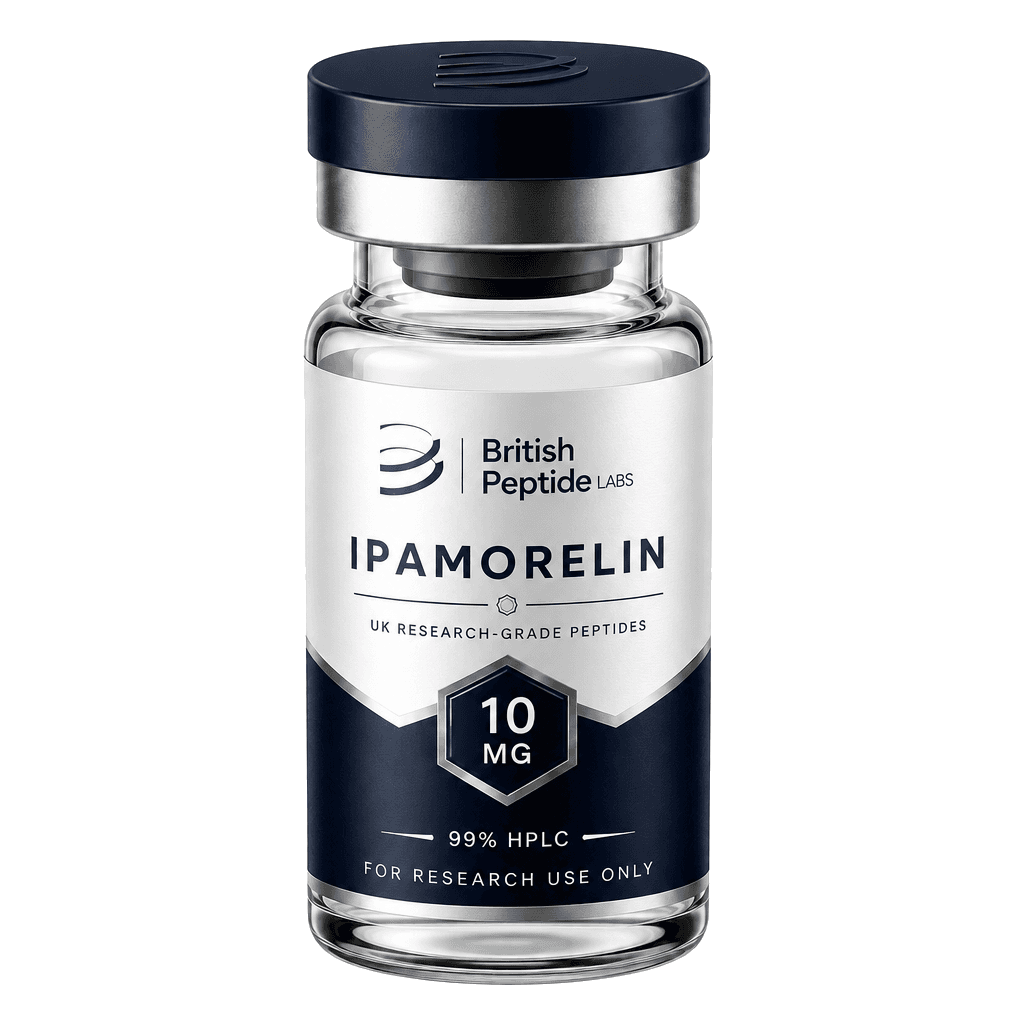
Ipamorelin
In stock · 10 mg
£55.00
£5.50/mg
Research area
For research use only. Not for human or veterinary use. Sold strictly for in-vitro laboratory research; not for diagnosis or treatment.
This research area groups analogues by the receptor class of the peptide each one is modelled on: GHRH, the GHS-R1a receptor and IGF-1. Tesamorelin is a GHRH analogue of forty-four amino acid residues carrying an N-terminal trans-3-hexenoyl group, with the formula C221H366N72O67S and a molecular weight of 5135.9 g/mol. Ipamorelin is a pentapeptide GHS-R1a ligand, Aib-His-D-2-Nal-D-Phe-Lys-NH2, which combines an α-aminoisobutyric acid residue, two D-configured aromatic residues and a C-terminal amide. IGF-1 LR3 is a recombinant single-chain IGF-1 analogue of eighty-three residues; its name refers to an arginine at position 3 and an extended N-terminus. The three range from a pentapeptide to a small protein.
In stock · 10 mg
£55.00
£5.50/mg
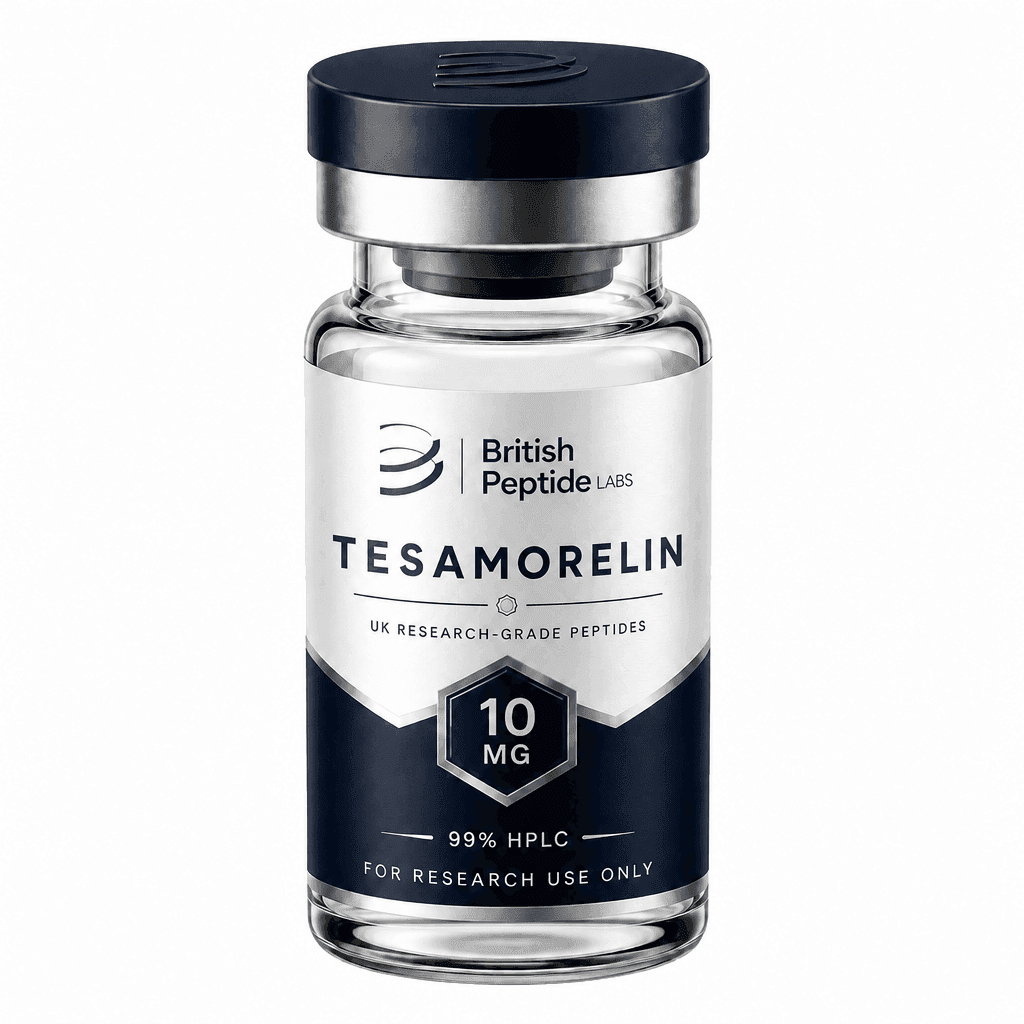
Out of stock · 10 mg
£85.00
£8.50/mg
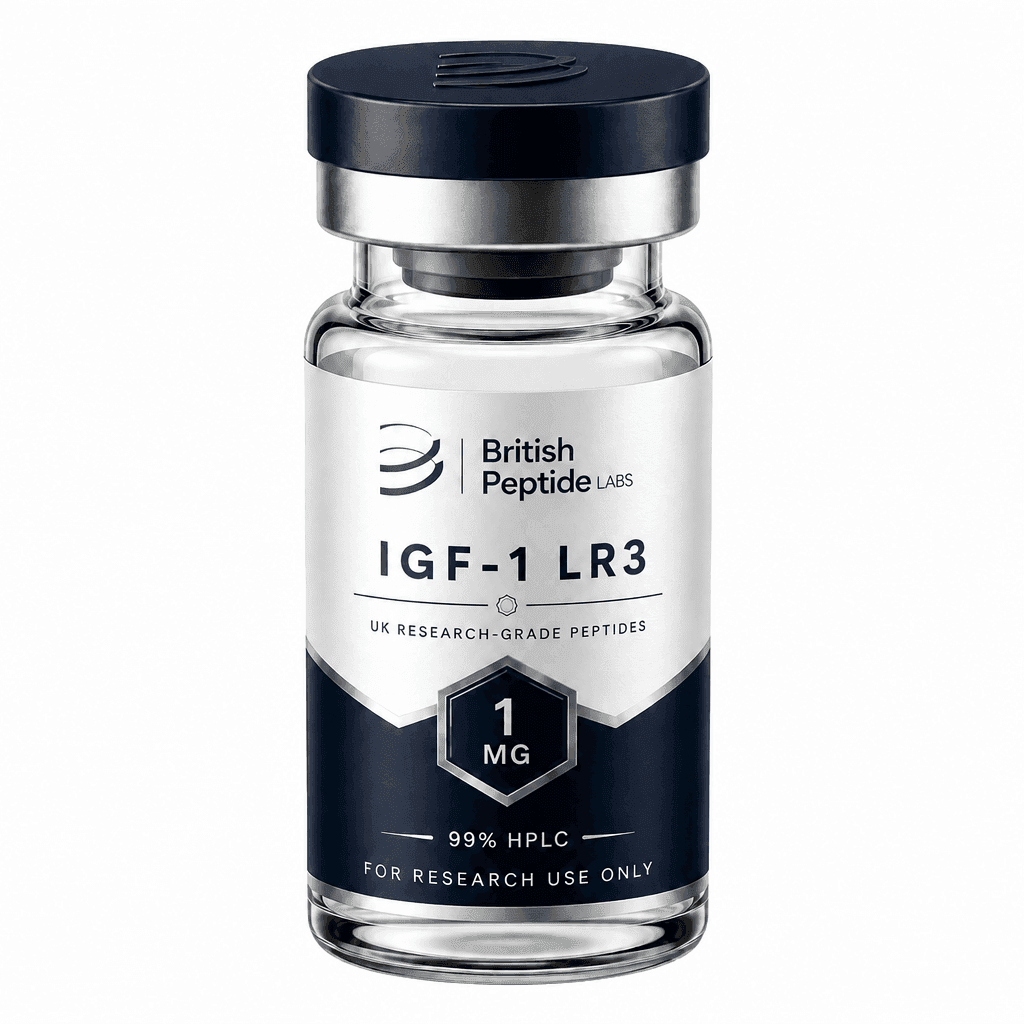
Out of stock · 1 mg
£85.00
£85.00/mg
The three compounds in this area span a wide range of chain lengths, and each shows a different way of modifying a natural sequence. Tesamorelin keeps the forty-four-residue sequence of GHRH(1–44) and adds a single group at the N-terminus: a trans-3-hexenoyl acyl chain, a six-carbon unit with one carbon–carbon double bond in the E configuration. Its formula, C221H366N72O67S, contains one sulfur atom, from the single methionine in the chain; there is no cysteine and therefore no disulfide bridge.
Ipamorelin takes the opposite approach: a pentapeptide, H-Aib-His-D-2-Nal-D-Phe-Lys-NH2, in which three of the five residues are non-standard. Aib (α-aminoisobutyric acid) carries two methyl groups on its α-carbon; D-2-Nal is 3-(2-naphthyl)-D-alanine, an aromatic residue with a naphthalene side chain; and D-Phe is the D-enantiomer of phenylalanine. The C-terminal lysine ends in an amide rather than a free acid.
IGF-1 LR3 is the only recombinant product in the area: a single-chain polypeptide of eighty-three residues, produced by expression in a host organism rather than by stepwise chemical synthesis. Its name refers to an arginine at position 3 and a lengthened N-terminus, and at this length it sits at the boundary between peptides and small proteins. Unlike the two synthetic peptides, its sequence and chain length are fixed by the expression construct rather than built up by successive coupling steps.
The table gives each compound's identifiers and residue count, from five residues for ipamorelin to eighty-three for IGF-1 LR3. Ipamorelin's 711.85 g/mol and tesamorelin's 5135.9 g/mol are both calculated from their full formulas, including the C-terminal amide of one and the N-terminal hexenoyl group of the other. The price column gives the lowest cost per milligram across each compound's vials, which is the clearest way to read an area whose products come in very different vial masses, from the recombinant polypeptide to the two synthetic peptides beside it.
| Compound | CAS number | Molecular formula | Molecular weight | Residues | From, per mg |
|---|---|---|---|---|---|
| Ipamorelin | 170851-70-4 | C38H49N9O5 | 711.85 g/mol | 5 | £5.50 |
| Tesamorelin | 218949-48-5 | C221H366N72O67S | 5135.9 g/mol | 44 | £8.50 |
| IGF-1 LR3 | 83 | £85.00 |
Residue-level detail sits on each product page. Within this area, read the structure notes on Ipamorelin and Tesamorelin.
Unlike most areas in the catalogue, this one is organised by the receptor class of the peptide each compound is modelled on rather than by a single structural motif. That gives it the widest spread of chain lengths in the store: a pentapeptide, a forty-four-residue acylated chain and an eighty-three-residue recombinant polypeptide. The class is held together by the parent peptides, GHRH, the GHS-R1a receptor ligands and IGF-1, while the chemistry of each member is read from its own identifiers.
The three also show three separate routes to a modified sequence. Tesamorelin keeps a natural chain of forty-four residues and caps its N-terminus with a trans-3-hexenoyl group. Ipamorelin is built mostly from non-standard residues, with Aib, two D-configured aromatic residues and a C-terminal amide across five positions. IGF-1 LR3 carries an arginine at position 3 and a lengthened N-terminus on a recombinant chain. Each route leaves a different signature: a mass offset from the acyl group, a stereochemistry that mass alone cannot show, and a sequence length fixed by the expression construct.
Because the members differ so widely, each product page in this area carries the identifiers for its own compound, and the table on this page gathers them in one place. The receptor-class grouping tells you which parent peptide a compound is modelled on; the formula, the molecular weight and the residue count tell you what has been built on that model.
Analysis has to match the scale of each molecule. Ipamorelin, at 711.85 g/mol, gives a simple mass spectrum dominated by singly and doubly charged ions, and its naphthyl and phenyl side chains absorb strongly in the ultraviolet, which helps detection. Its two D-residues matter analytically as well: a diastereomer in which one of them is replaced by its L-form has the same formula and mass, so it can be distinguished chromatographically but not by mass alone. Because ipamorelin ends in an amide, a deamidated form with a free C-terminal acid differs from it by only about 1 Da, so the expected mass has to be matched closely.
Tesamorelin, at 5135.9 g/mol, is analysed like other long synthetic peptides: reversed-phase HPLC for the chromatographic profile, and electrospray mass spectrometry, deconvoluted from multiply charged ions, for identity. Its methionine can oxidise to the sulfoxide, which adds 16 Da and usually elutes slightly earlier than the parent peak. Recombinant polypeptides such as IGF-1 LR3 are commonly characterised by reversed-phase HPLC and mass spectrometry too, often alongside SDS-PAGE for apparent molecular mass. At eighty-three residues, its deconvoluted mass is compared with the average mass calculated from the full sequence.